
Bedwetting: Why It Happens and What Helps
Why children wet the bed, what really helps (and what doesn’t), bedwetting alarms and medicine, protecting self-esteem, and when to talk to your pediatrician.

How to stop homework battles: a routine that works, how much help to give, the 10-minute rule, dealing with procrastination and when to talk to the teacher.
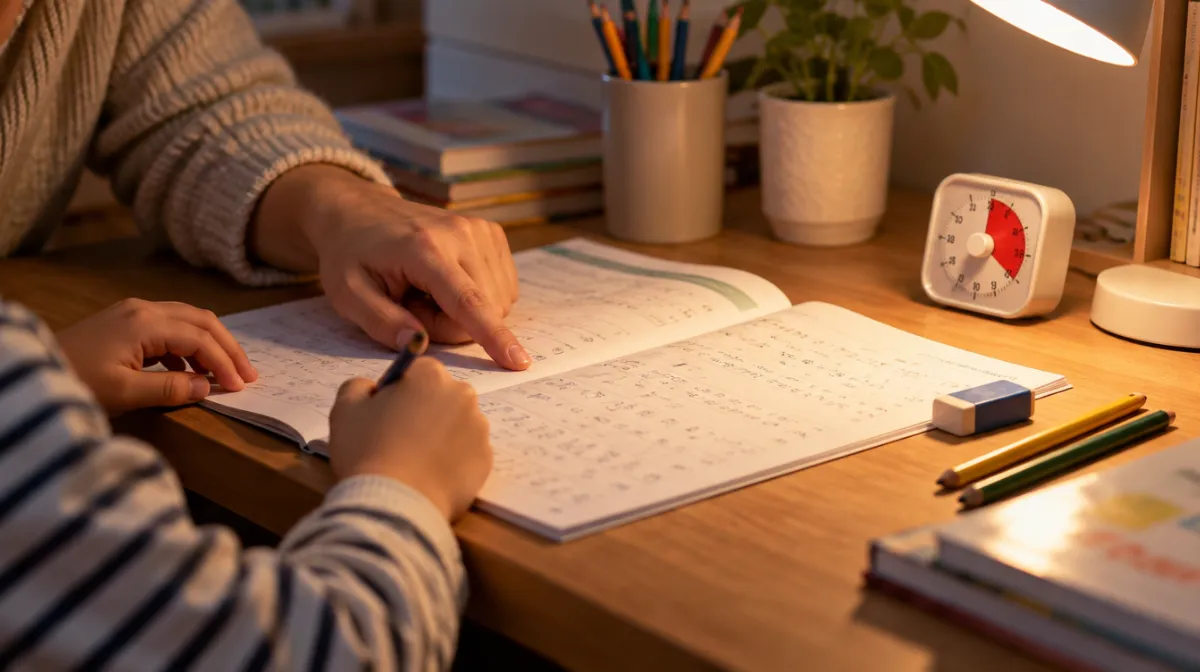
For many families, the hardest part of the school day starts after school: the stalling, the sighing, the “I don’t get it”, the erasers thrown across the table. Homework battles are common, and they’re rarely about the homework itself. They’re about tiredness, feeling stuck, wanting control and a routine that hasn’t settled. The good news is that a few changes usually cool things down quickly.
The aim is to make homework a habit, not a daily debate.
A predictable after-school routine helps evenings run smoothly too; see our bedtime routine guide.
Think coach, not co-author.
A widely cited guideline, endorsed by the National Education Association and the National PTA, is the “10-minute rule”: about 10 minutes per grade level per night, so roughly 20 minutes in second grade and 60 minutes in sixth. Schools vary, but if your child is regularly spending far longer than that, something may be wrong: the work may be too hard, your child may be distracted, or the load may simply be too heavy.
Teachers generally want to know when homework isn’t working. Reach out if:
Ask what the homework is meant to show, how long it should take and whether adjustments are possible.
Persistent struggles can point to a learning difference such as dyslexia, a problem with attention such as ADHD, anxiety or vision and hearing problems. Signs include avoiding reading or writing, trouble remembering instructions, very slow work despite effort and frequent complaints of headaches or stomachaches before homework. Talk to the school and your pediatrician about an evaluation; early support makes a big difference.
School-age children need plenty of sleep, and a stressed, overtired child finds everything harder. If homework runs into bedtime, it’s time to rethink the schedule with the school. Kids also need free play, time outdoors and family time, which support learning too.
Usually not. Point out one thing to check if you like, but let the teacher see your child’s real work. Save redos for work that’s clearly careless.
Help them understand the question and how to approach it, but avoid giving answers. Teachers need to know what your child can do alone.
Use a consistent routine, start with a snack and a check-in, break work into short chunks and step back once they’ve started.

Every article is edited by a human and checked against our editorial policy. Spotted a mistake? Tell us.
Why children wet the bed, what really helps (and what doesn’t), bedwetting alarms and medicine, protecting self-esteem, and when to talk to your pediatrician.
What age should kids get a first phone? Signs of readiness, basic phone vs. smartphone, parental controls, a family phone agreement and social media age limits.
Why toddlers have tantrums, what to do in the moment at each age, how to prevent the next one, and when tantrums are a reason to talk to your pediatrician.